---
title: "Summer hunting shotshells: how to choose the right ballistic setup."
description: Discover how to choose the right shotshells for summer conditions. Learn how powder type, payload weight and high temperatures affect hunting performance.
image: https://blog.hunting-spot.com/hubfs/cartucce-estive-giuste.png
---
- [Hunting Spot](https://www.hunting-spot.com/)
- [About us](https://www.hunting-spot.com/en/about-us/)
- [What we do](https://www.hunting-spot.com/en/what-we-do/)
- [Work with us](https://blog.hunting-spot.com/en/collaborate-with-us)
- [FAQ](https://https://www.hunting-spot.com/en/faq/)
- [Contact us](https://blog.hunting-spot.com/en/contact-us)
- [Subscribe to newsletter](https://blog.hunting-spot.com/en/subscribe-to-newsletter)
- Blog
- [Hunting](https://blog.hunting-spot.com/en/topic/hunting)
- [Upland](https://blog.hunting-spot.com/en/topic/upland)
- [Big Game](https://blog.hunting-spot.com/en/topic/big-game)
- [Turkey](https://blog.hunting-spot.com/en/topic/turkey)
- [Waterfowl](https://blog.hunting-spot.com/en/topic/waterfowl)
- [Shooting](https://blog.hunting-spot.com/en/topic/shooting)
- [Clay Shooting](https://blog.hunting-spot.com/en/topic/clay-pigeon-shooting)
- [Guns & Ammo](https://blog.hunting-spot.com/en/topic/guns-ammo)
- [Shells, Gunpowders and Reloading](https://blog.hunting-spot.com/en/topic/shells-gunpowders-and-reloading)
- [Pistols, Shotguns and Rifles](https://blog.hunting-spot.com/en/topic/pistols-shotguns-and-rifles)
- [Equipment and Tips](https://blog.hunting-spot.com/en/topic/equipment-and-tips)
- Policies
- [Privacy Policy](https://www.iubenda.com/privacy-policy/8274560)
- [Cookie Policy](https://www.iubenda.com/privacy-policy/8274560/cookie-policy)
- [](https://www.facebook.com/BaschieriePellagri)
- [](https://www.instagram.com/baschieriepellagri/)
- [](https://twitter.com/bp_italia)
- [](https://www.youtube.com/channel/UC9WXJOSxsqxBPNF3QMql3kw)
- [About us](https://www.hunting-spot.com/en/about-us/)
- [What we do](https://www.hunting-spot.com/en/what-we-do/)
- [Work with us](https://blog.hunting-spot.com/en/collaborate-with-us)
- [FAQ](https://www.hunting-spot.com/en/faq/)
- [Contact us](https://blog.hunting-spot.com/en/contact-us)
- [Subscribe to newsletter](https://blog.hunting-spot.com/en/subscribe-to-newsletter)
- [Facebook](https://www.facebook.com/BaschieriePellagri/)
- [Instagram](https://www.instagram.com/baschieriepellagri/)
- [Twitter](https://twitter.com/BP_Italia)
- [Youtube](https://www.youtube.com/channel/UC9WXJOSxsqxBPNF3QMql3kw)
[](https://www.hunting-spot.com/en/)
- [Hunting](https://blog.hunting-spot.com/en/topic/hunting)
- [Upland](https://blog.hunting-spot.com/en/topic/upland)
- [Big Game](https://blog.hunting-spot.com/en/topic/big-game)
- [Turkey](https://blog.hunting-spot.com/en/topic/turkey)
- [Waterfowl](https://blog.hunting-spot.com/en/topic/waterfowl)
- [Shooting](https://blog.hunting-spot.com/en/topic/shooting)
- [Clay Shooting](https://blog.hunting-spot.com/en/topic/clay-pigeon-shooting)
- [Guns & Ammo](https://blog.hunting-spot.com/en/topic/guns-ammo)
- [Shells, Powders and Reloading](https://blog.hunting-spot.com/en/topic/shells-gunpowders-and-reloading)
- [Pistols, Shotguns and Rifles](https://blog.hunting-spot.com/en/topic/pistols-shotguns-and-rifles)
- [Equipment & Tips](https://blog.hunting-spot.com/en/topic/equipment-and-tips)
- [B&P World](https://blog.hunting-spot.com/en/topic/bp-world)
- [B&P Shotshells and Products](https://blog.hunting-spot.com/en/topic/shotshells-and-products)
# Read all the posts
[Go to homepage](https://www.hunting-spot.com/en/)
# Summer hunting shotshells: how to choose the right ballistic setup.
28 Jul, 2026 author [Simone Manetti](https://blog.hunting-spot.com/en/author/simone-manetti)
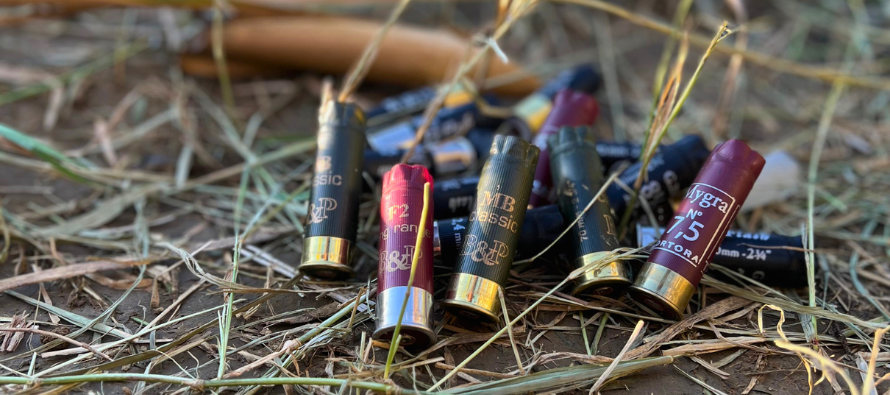
In recent years, driven by steadily rising temperatures, hunters have increasingly found themselves hunting in "summer-like" conditions well into October. Choosing the right shotshell for these conditions has therefore become more important than ever.
Two fundamental factors should guide your choice: powder burn rate and payload weight. When temperatures rise, it is best to select shotshells loaded with fast- or medium-fast-burning powders. These propellants burn rapidly, accelerating the shot charge to high velocity while producing a rapid initial pressure peak that drops significantly before reaching the muzzle.
The primary ballistic benefit? Low residual muzzle pressure. This prevents severe muzzle blast turbulence from disturbing the pellet column as it leaves the barrel, ensuring denser, more uniform shot patterns.
As for payloads, light to medium loads are generally the best choice. These loads provide all the effectiveness required by modern ethical hunting, especially when game birds have not yet developed their full plumage and most shots are taken at moderate rather than long distances.
## Choosing the right payload weight
During the warmest part of the hunting season, light and medium payloads are, in my opinion, the most suitable option. The recommended ranges for the gauges most commonly used in Italy are:
- **12 gauge:** from 28 to a maximum of 36 grams;
- **16 gauge:** from 27 to 30 grams;
- **20 gauge:** from 24 to 29 grams;
- **28 gauge:** from 18 to 24, maximum 26 grams;
- **.410:** from 12 to 18-19 grams.
In small-bore shotguns, particularly the 28 gauge and .410, payload weights have shifted toward heavier charges compared to the past. This evolution reflects modern hunting habits: these smaller calibers are now widely used across all forms of upland and walk-up hunting rather than being restricted to fixed blinds. To ensure clean, ethical kills, payloads must remain proportional to the game and shooting distance.
### Does powder quality really matter?
The short answer is: absolutely. During hot, dry weather, using powders engineered for thermal stability and clean combustion is essential. High ambient temperatures naturally accelerate the burn rate of any propellant, increasing chamber pressure.
These propellants maintain consistent combustion even at high temperatures, helping to avoid excessive pressure peaks. Hunters who handload their own ammunition should reduce powder charges, and sometimes even shot weight compared to winter loads, since higher temperatures naturally increase powder burn rate and chamber pressure.
For those using factory-loaded ammunition, the best choice is a shotshell that combines low residual muzzle pressure with high velocity. This offers several important advantages, including reduced recoil and improved pellet sphericity, both essential for producing even, well-distributed shot patterns.
## Clay target shotshells for summer hunting: yes or not?
Target shotshells engineered for clay disciplines are frequently used for summer hunting, but is it a sound ballistic choice?
In the past, specially developed "counter-loads" were widely popular in southern Europe, where summer temperatures routinely exceed 35°C (95°F). These shotshells were tailored to achieve extremely high muzzle velocities with lighter-than-standard shot charges.
As ballistics expert Gianluca Garolini explains: "*A shot charge leaving the muzzle at 1,378–1,411 fps will retain sufficient residual velocity—even under the most unfavorable atmospheric conditions—to deliver adequate kinetic energy on target.*"
Looking at modern sporting loads, especially those engineered for Sporting Clays and Compak, many 28-gram shotshells deliver muzzle velocities V1 between 1,378 fps and 1,444 fps. These shotshells can indeed be used with great success for early-season hunting, particularly on days characterized by high barometric pressure (above 1020 hPa).
## My preferred summer hunting loads
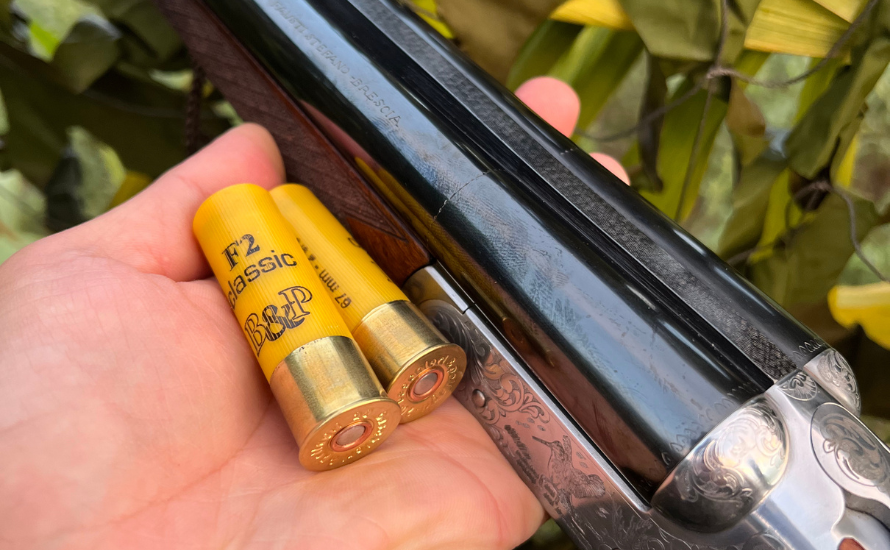
Theory provides valuable guidance, but field experience is ultimately what convinces every hunter. Over the past few years I have mainly hunted dove, wood pigeon and upland game during the hottest months, using three firearms in particular:
- Beretta S2 – 12 gauge
- Benelli M2 – 20 gauge
- Beretta A400 – 28 gauge
In 12 gauge, the shotshells that have consistently delivered the best results are [MB Gigante, MB Classic](https://www.baschieri-pellagri.com/linea/mb/), [Mygra Tortora](https://www.baschieri-pellagri.com/prodotto/mygra-tortora/), and [AL](https://www.baschieri-pellagri.com/prodotto/al/). Alongside these trusted choices, I have increasingly come to appreciate the lighter 30 grams and 32 grams Privilege Game loads.
In 20 gauge, my preferred shotshells are [F2 Classic and F2 Classic Fiber](https://www.baschieri-pellagri.com/linea/f2/),reliable companions throughout the season, even in the hottest weather. And when conditions become particularly demanding, an F2 Long Range always finds its place in my Benelli.
Finally, in 28 gauge, my first barrel is almost always loaded with the [21 grams Extra Rossa Fiber](https://www.baschieri-pellagri.com/prodotto/extra-rossa-28-fiber/), paired or followed by the [22 g Extra Rossa](https://www.baschieri-pellagri.com/prodotto/extra-rossa-28/) with plastic wad for the second shot. For more challenging opportunities, or as a final option, the 26 grams [Extra Rossa HV](https://www.baschieri-pellagri.com/prodotto/extra-rossa-28-hv/) remains a proven and highly effective choice.
### [Simone Manetti](https://blog.hunting-spot.com/en/author/simone-manetti)
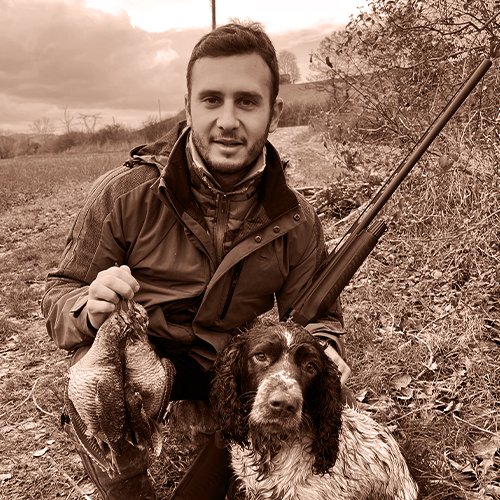
Pisano - e si sente! - nasce nel 1993 da una genealogia di cacciatori. Conosce prima il fucile dell’alfabeto. Laureato in economia, è appassionato di vini e buona cucina, di outdoor e del proprio territorio. Se gli danno torto ha la battuta pronta: not politically correct.
[More posts from Simone Manetti](https://blog.hunting-spot.com/en/author/simone-manetti)
**Share this post:**
**Facebook** **Twitter** **Google Plus** **LinkedIn**
### Related posts
[0](https://blog.hunting-spot.com/en/legend-gen-pattern-testing-and-ballistic-evaluation#comments-listing) [](https://blog.hunting-spot.com/en/legend-gen-pattern-testing-and-ballistic-evaluation)
[B&P Legend Gen: pattern testing and ballistic evaluation of a new generation.](https://blog.hunting-spot.com/en/legend-gen-pattern-testing-and-ballistic-evaluation)
For 2026, B&P introduces the new Legend Gen line, an evolution of the iconic Legend series and the...
[0](https://blog.hunting-spot.com/en/nike-extra-hp-the-new-shotshell-for-wood-pigeon-hunting#comments-listing) [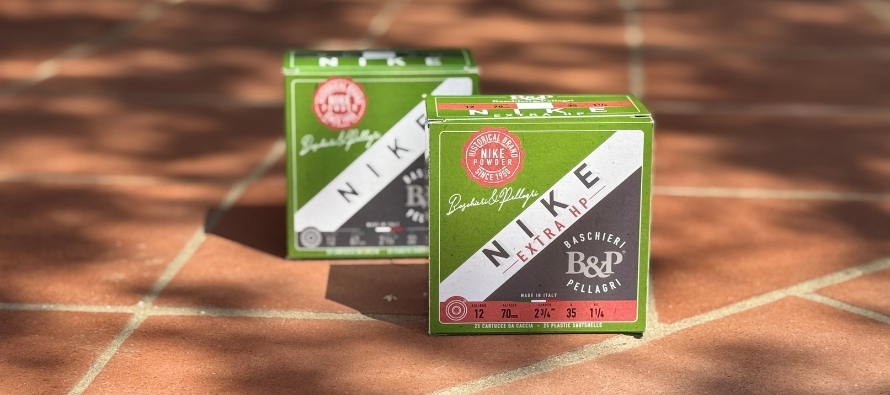](https://blog.hunting-spot.com/en/nike-extra-hp-the-new-shotshell-for-wood-pigeon-hunting)
[Nike Extra HP: the new HP shotshell for wood pigeon hunting](https://blog.hunting-spot.com/en/nike-extra-hp-the-new-shotshell-for-wood-pigeon-hunting)
Baschieri & Pellagri continues to innovate its hunting ammunition range with the introduction of...
[0](https://blog.hunting-spot.com/en/legend-gen-discover-the-new-generation#comments-listing) [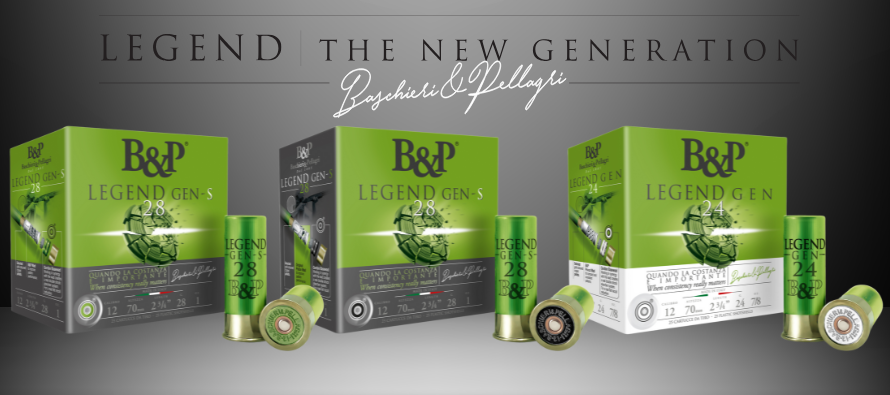](https://blog.hunting-spot.com/en/legend-gen-discover-the-new-generation)
[Legend Gen: discover the new generation!](https://blog.hunting-spot.com/en/legend-gen-discover-the-new-generation)
Some products are not created to impress, but to refine what already works. Legend Gen is one of...
### Comment this post
### New Posts
[See all](https://blog.hunting-spot.com/en)
[Summer hunting shotshells: how to choose the right ballistic setup.](https://blog.hunting-spot.com/en/how-to-select-the-best-shotshells-for-hot-weather)
In recent years, driven by steadily rising temperatures, hunters have increasingly found themselves hunting in...
[**Read more**](https://blog.hunting-spot.com/en/how-to-select-the-best-shotshells-for-hot-weather) [July 28](https://blog.hunting-spot.com/en/how-to-select-the-best-shotshells-for-hot-weather)
[B&P Legend Gen: pattern testing and ballistic evaluation of a new generation.](https://blog.hunting-spot.com/en/legend-gen-pattern-testing-and-ballistic-evaluation)
For 2026, B&P introduces the new Legend Gen line, an evolution of the iconic Legend series and the result of a...
[**Read more**](https://blog.hunting-spot.com/en/legend-gen-pattern-testing-and-ballistic-evaluation) [June 26](https://blog.hunting-spot.com/en/legend-gen-pattern-testing-and-ballistic-evaluation)
[Built for the hunt: discover B&P’s 2026 innovations.](https://blog.hunting-spot.com/en/discover-bp-2026-innovations)
Among Baschieri & Pellagri’s new products for 2026, there are several exciting additions for both hunting and clay...
[**Read more**](https://blog.hunting-spot.com/en/discover-bp-2026-innovations) [June 08](https://blog.hunting-spot.com/en/discover-bp-2026-innovations)
### Subscribe to our Newsletter
Copyright © 2024 - **Powered by Baschieri & Pellagri** - [www.baschieri-pellagri.com](http://www.baschieri-pellagri.com/?__hstc=232301056.b8772c39e461643e750caac5a00db33d.1505298295628.1505298295628.1505300931779.2&__hssc=232301056.1.1505300931779&__hsfp=2446219160)
Via del Frullo, 26 - 40055 Marano di Castenaso, Bologna
Email: [team@hunting-spot.com](mailto:team@hunting-spot.com)
- [Privacy Policy](https://www.iubenda.com/privacy-policy/8274560)
- [Cookie Policy](https://www.iubenda.com/privacy-policy/8274560/cookie-policy)
- [Subscribe to newsletter](https://blog.hunting-spot.com/en/subscribe-to-newsletter)
- [Contact us](https://blog.hunting-spot.com/en/contact-us)
