



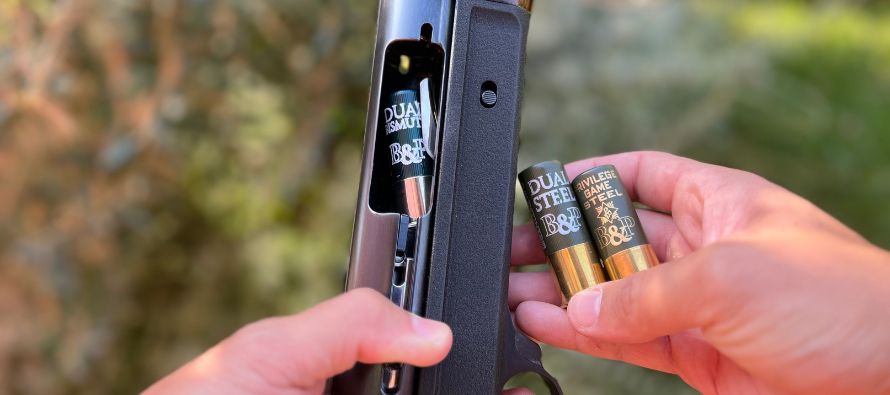
My aim in this article is to provide concrete answers tailored to each type of hunting, based on what I have been able to test in the field and on the pattern range over the past three years thanks to B&P.
Before diving into this thorny subject, I want to stress that I do not intend to debate the ill-considered legislative choices that have led to these bans. At present, B&P offers a range of alloys broad enough to meet the needs of every hunter, and that in itself is excellent news compared with the situation just ten years ago.
The ballistic performance of lead alternatives differs from one alloy to another, but overall, it has certainly improved over the years thanks to the study of specific components and load configurations.
On this blog, you will find essential deep dives by Gianluca Garolini, very useful for understanding the topic:
Another highly recommended step is to download the 2025 catalogue, which is packed with all the information needed to shoot safely and is useful for understanding the material we will cover below.
Before talking about shotshells, let us spend a moment on shotguns.

Old shotguns and lead-free shotshells: yes or no?
Do all lead-free shotshells require a choked and steel-proof barrel? No.
Good news for lovers of older guns: Benelli 121, Beretta 300 series, Browning b25, and fine side-by-side shotguns that made the hunting history of our country and beyond, and that can still provide great hunting experiences, can still be used.
In these firearms, provided they are well preserved, there are essentially two categories of shotshells that can be safely fired:
- Bismuth-loaded shotshells, whose performance is almost equivalent to lead. An example is the Dual Bismuth family, which is also available in a revolutionary Fiber version, allowing, for the first time, the use of a lead-alternative alloy without a container wad.
- Light steel (iron) shotshells such as One Steel 28 and 30 and Dual Steel 28, suitable for small game or for shots that are not overly demanding, roughly up to 30–32 metres.
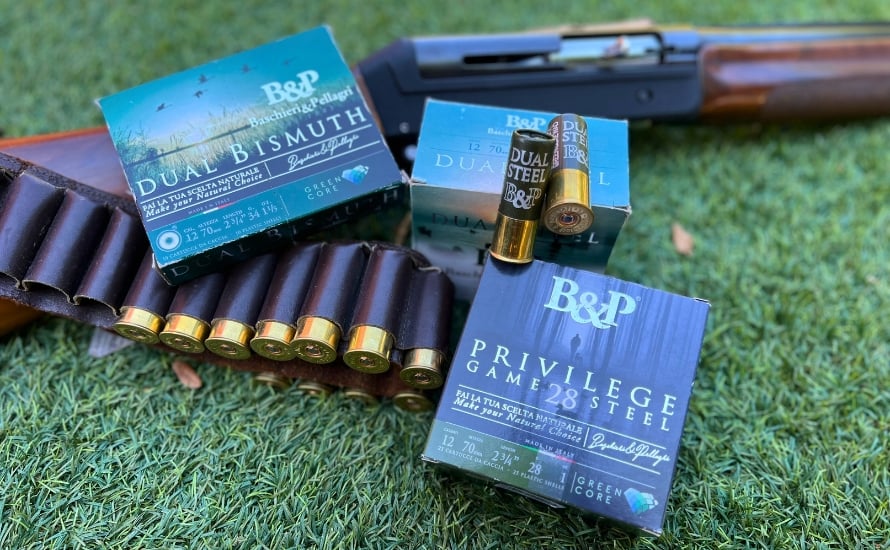
What the CIP limits impose in Europe
Why can steel shotshells of 28 and 30 grams be fired in non-choked PSF* shotguns? It all depends on the notorious CIP, the international authority that defines technical standards for ammunition.
The regulation refers to the momentum, calculated as the product of mass and velocity. Denoted as “EM” (energy of motion) in the text you read, “m” is mass and “v” is velocity, so EM is their simple product. A key parameter for hard pellets under CIP rules is the “momentum”, the product of the velocity measured at 2.5 metres from the muzzle in a cylinder bore, multiplied by the mass of the shot.
For standard homologation in 12 gauge (maximum pressure < 740 bar with PSF* stamping — the small star and no proof mark), the EM value is 12 and the maximum pellet diameter permitted is 3.25 mm, which corresponds to size No. 4. The allowed choke can be up to full. This means that a 28-gram load of No. 4 steel, copper-plated steel, or tungsten pellets may reach a V2.5 (cylindrical) of about 428.5 m/s, while a 30 grams load may be limited to about 400 m/s.
Both these loads can therefore be fired even through heavily choked barrels.
For proofed (⚜️) shotguns, tested at a maximum pressure of 1320 bar, the values of momentum (EM) rise: to 13.5 for 12 HP, 15 for 12/76, and 19 for 12/89. In these three cases, pellet diameter is not dimensionally limited, though if it exceeds 4 mm, the maximum permitted choke will be improved modified.
So, is it worth buying a choked shotgun? It depends. If you will often hunt in wetlands, then owning a choked gun is convenient because it will allow you to use all types of available no-toxic shotshells. Otherwise, if you only occasionally hunt in such areas, you can manage by choosing the right shotshells for your non-choked shotgun.
Let us now look at practical solutions for the various forms of hunting, starting from one that is particularly dear to me: small migratory game.
Hunting small migratory game with lead-free shotshells: is it possible?
I started hunting small migratory game with a single-barrel "Mavi" in 28 gauge, accompanying my grandfather to his hide near the Dead River, just a few kilometres from the Leaning Tower of Pisa If that area had not become a protected wetland zone, it probably would have been classified as a wetland. How then to hunt small game in these areas?
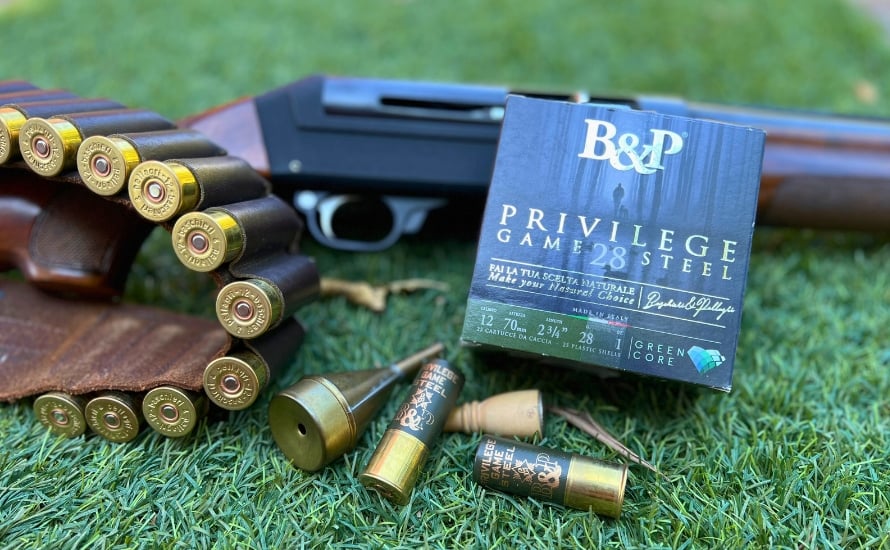
On page 33 of the catalogue, there is a two-pronged solution: the One Steel family. Two brand new shotshells loaded with 28 and 30 grams of steel shot, boasting a muzzle velocity of 430 m/s for the 28 g and 415 m/s for the 30. They are already available with pellet sizes No. 9.5, 8.5 and 7, which roughly correspond to lead No. 10.5, 9.5, and 8.5, respectively.
These shotshells are therefore perfect for use on small migratory game. Thrushes, blackbirds, starlings, woodcocklets or larks can be hunted with any shotgun in good condition, even a non-choked one, and with any choke.
The second solution is on page 72 and is called Privilege Game Steel 28. Compared with One Steel 28, this shotshell — also safe to fire from any gun, performs better because it is assembled with the 100% biodegradable Green Core container wad, which we have seen guarantees exceptional patterns. It is available with No. 5 pellets — roughly equivalent to No. 7 in lead — and in my view is decisive for hunting fieldfares or woodcocklets, or as a second or third load even on thrushes and blackbirds.
Small calibres options
This year B&P made a bold move. The novelty is called Extra Rossa Bismuth: the effectiveness is unchanged even without lead. Four new shotshells have been released, listed on page 9 of the catalogue: two for 28 gauge and two for .410:
- Extra Rossa 28 Bismuth, loaded with a container wad and 21 g of bismuth shot, sizes No. 7 to 4.
- Extra Rossa 28 Bismuth Fiber, loaded with a felt wad and 19 g of bismuth shot, sizes No. 7 to 5.
- Extra Rossa .410 Bismuth, loaded with a container wad and 16 g of bismuth shot, sizes No. 7 to 4.
- Extra Rossa .410 Bismuth Fiber, loaded with a felt wad and 15 g of bismuth shot, sizes No. 7 to 5.
As emerged from the plate tests, the performance of these shotshells is outstanding; I challenge anyone to say otherwise. The difference with lead is not noticeable, neither in the field nor on the plate. These shotshells give small-gauge lovers the freedom to hunt without limits: every form of hunting can be practised with satisfaction, in any geographic area.
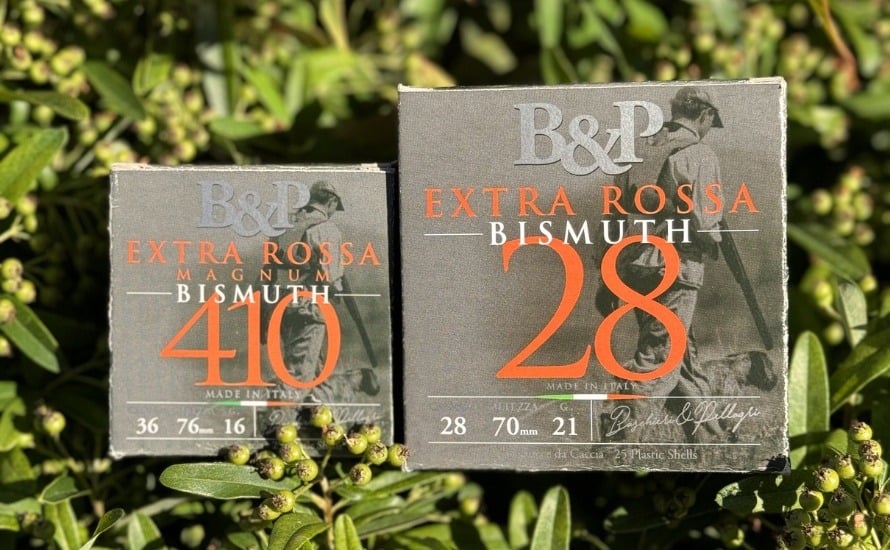
Why no steel for small gauges? At the moment, while the CIP limits remain as they are, there is little that can be done. Steel needs to be launched at very high velocities to be effective on game, and that is currently impossible while respecting the rules on momentum. If you have seen some American companies offering solutions, that is because their standard (SAAMI) differs, but at present, this is not feasible in Europe.
Pointing breeds and searching dogs, and “no-toxic” ammunition

“God saves the bismuth!” to paraphrase our English friends. The bismuth has often been approached sceptically because of the unacceptable performance of some shotshells, mainly of English origin, presented about a decade ago. But the modern bismuth is not remotely comparable to the alloys of those years that tended to fragment. Today, bismuth represents one of the most interesting solutions.
Baschieri & Pellagri has introduced a shotshell that, in my opinion, did not get the attention it deserves: the Dual Bismuth Fiber 32, shown on page 52 of the general catalogue and also available in 20 gauge loaded with 26 g of pellets.
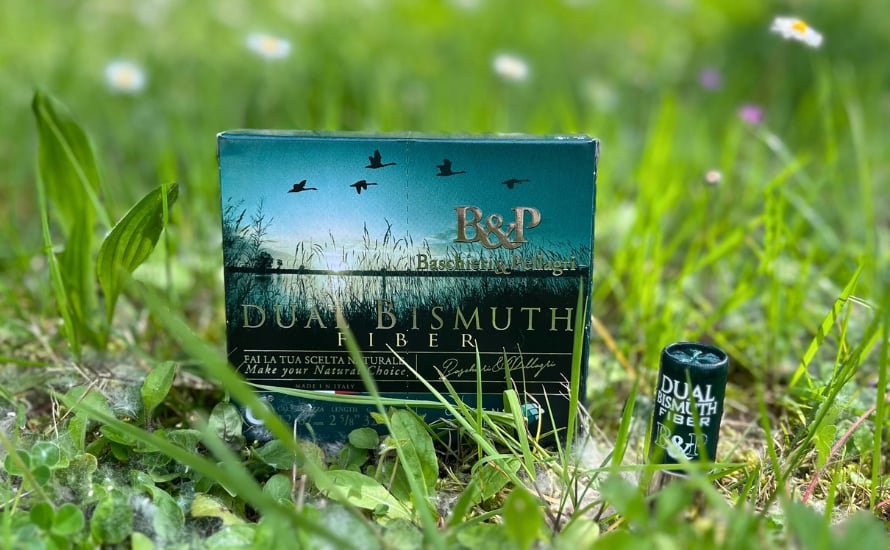
This is an exceptional solution because it is the first lead-alternative alloy loaded with a felt wad — in practical terms, the missing first barrel is back. The couvette used is the biodegradable Green Core, so this shotshell can be considered 100% no-toxic anywhere in the world.
Furthermore it is loaded in a 67 mm case, so it can be fired in any shotgun. Bismuth is fully comparable to lead in use and very similar in performance.
Loaded with a 4+3 pellet configuration to increase pattern reach — corresponding to a 5+4 in lead — it can be used across the board: from pheasant to hare, on any anatidae and even on mountain game.
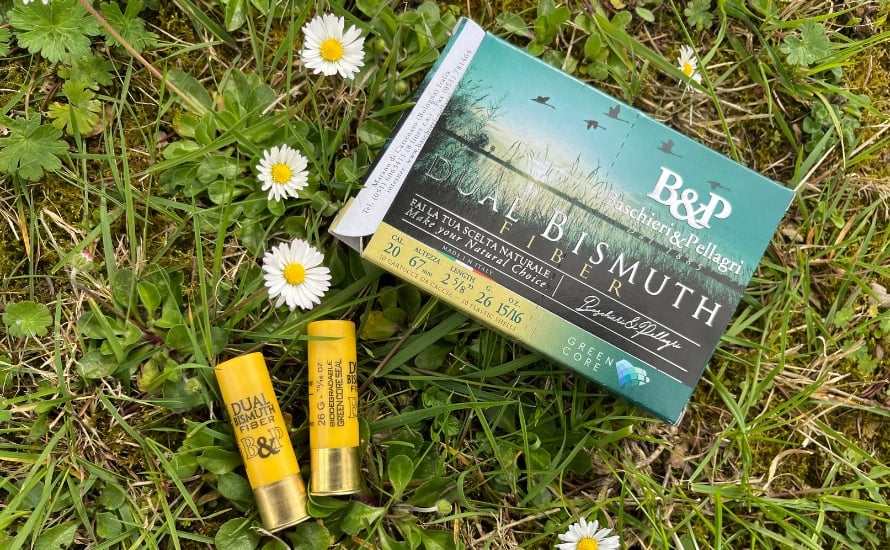
For second and third barrels, there are now two versions for 12 gauge and, finally, one for 20 gauge:
- Dual Bismuth 34 grams, in a 70 mm case with the container wad Green Core, increasing pattern reach to long distances.
- Dual Bismuth 38 grams, a high-performance shotshell loaded in magnum 12/76 case for best results in the most demanding hunting moments.
- Dual Bismuth 26 grams in 20 gauge. The important novelty here is the debut of the container Green Core wad in 20 gauge.
Mygra Beccaccia Bismuth: the queen
The European woodcock hunters were certainly among the most anxious during the legislative chaos of 2023. With unclear definitions of wetlands, many of the favoured habitats of the forest queen could be considered as such.
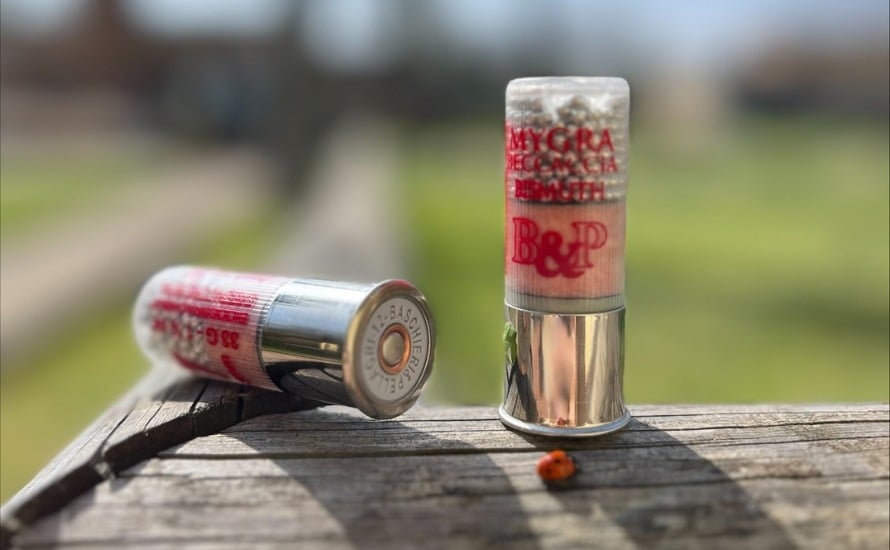
In response to this issue, prompted by countless requests, B&P presented the Mygra Beccaccia Bismuth, the bismuth version of the shotshell that for years has been highly appreciated by enthusiasts of this hunt.
Already plate-tested by Gianluca Garolini, it is a truly remarkable shotshell. Its components are among the best on the market: Gordon case, Green Core couvette and felt wad, 33 grams of selected bismuth No. 7 pellets (roughly equivalent to an 8 in lead), and a star crimp closure for the beautiful translucent case.
Nothing else to add: problem solved.
How to hunt ducks with lead-free shotshells
In the “vasche”, like the bathroom ones, as we call them in Tuscany — marshes, flooded fields or lagoons — the obligation to use no-toxic ammunition has been in force for years.
In these situations, owning a choked, “Steel Proof” shotgun is essential, and it allows the use of all four alloys: steel (iron), copper, bismuth and tungsten.
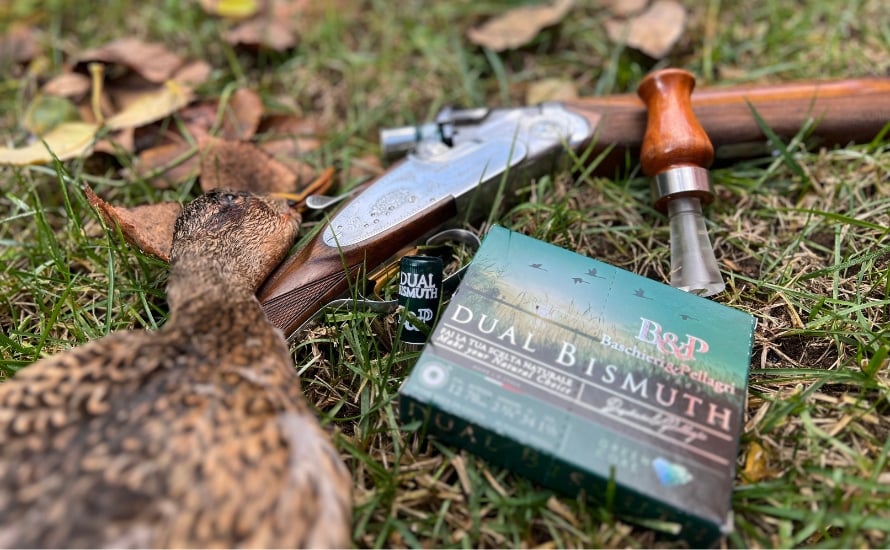
If invited occasionally by a colleague to a flooded hide, or if you temporarily blind at a wet field and want to use a non-choked gun, the shotshells to use are those mentioned earlier: One Steel 28 and 30, Privilege Game Steel 28, and all the Dual Bismuth, in descending order of effectiveness.
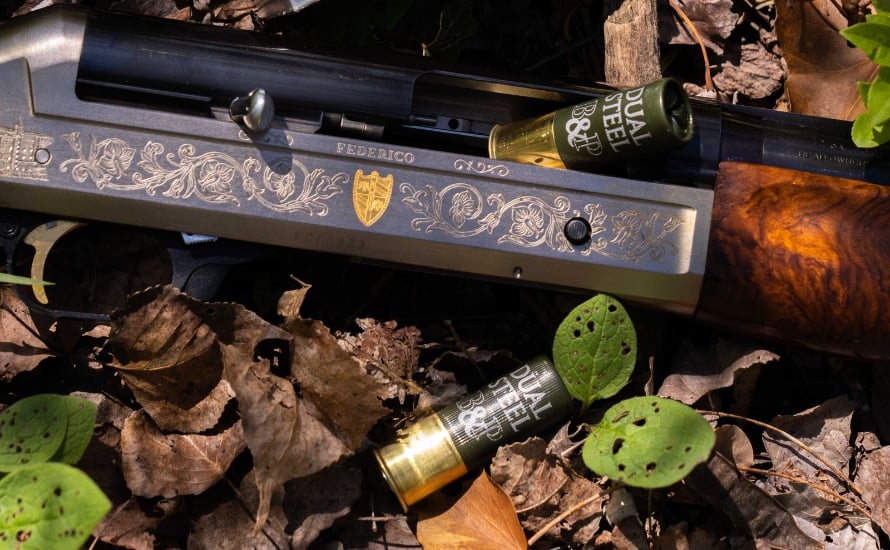
I would also definitely add the Dual Steel 28 on page 42 of the catalogue, in my opinion the best choice among steel loads. This one, loaded with a Green Core wad and two overlapping layers of iron and zinc-plated iron pellets (4+3), produces optimised patterns and ensures lethal power out to long distances.
For snipe and teal hunts, I would choose One Steel 28 and 30 because they are available with small pellets, as noted above.
Hunting wood pigeon: which shotshells to choose?
Given the habitats where wood pigeon is usually hunted, the problem usually does not arise; however, should it occur the following are possible solutions. If the number of shots is limited, I would certainly opt for Dual Bismuth 32 Fiber, Dual Bismuth 34, and in extreme cases the new 38: I had the opportunity to try them last season and found no performance difference compared to lead shotshells.
Alternatively, Dual Steel 28 (p. 42) and One Steel 28 (p. 33) can be good alternatives: the former for more demanding shots, the latter perhaps as a first barrel without excessive expectations.
Lead-free slug for wild boar hunting
For wild boar hunters, the suitable solution is certainly the Lead Free shot described on page 53 of the catalogue. It is an interesting and particular shotshell. To be fired only in PFS** proofed guns, it is made with a special tin alloy (with a specific gravity of 7.5 g/cm³) and is structurally identical to B&P’s lead slug.
Its distinctive feature is its velocity: around 600 m/s (1968 fps). The terminal effects produced by this projectile are very similar to those of rifled weapons, with pronounced nervous shock phenomena and very high lethality out to about 60–80 metres.
Conclusions and recommendations
To conclude, here is a brief summary of the shotshells that can be fired in all shotguns, even without the steel proof mark.

As stated previously, I am happy to recommend these shotshells only after testing them in both hunting conditions and on the pattern range, where — thanks to the professionalism of Gianluca Garolini — it was easy to understand the true performance of each.
I hope the situation evolves more clearly and positively than what currently appears on the horizon. In the meantime, I trust that this guide will help solve some of the choice problems you may face.

Comment this post